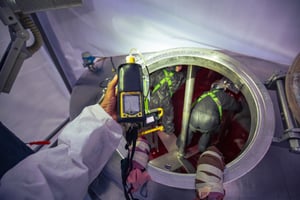
November is carbon monoxide month at JMS. Later this month, UK Carbon Monoxide Awareness Week will...
Where carbon monoxide turns up at work
This week is UK Carbon Monoxide Awareness Week, and its focus is homes: boilers, log burners and CO alarms. The same gas turns up at work, often from sources people don't think of as CO risks.
Our previous guide carbon-monoxide-explained explained what carbon monoxide is and how it affects the body. This one looks at where it comes from on site, and what helps.
Engines and generators
Any combustion engine produces carbon monoxide. Petrol engines produce the most, so pumps, generators, pressure washers and cut-off saws are common sources. Diesel engines produce much less CO, but not none. LPG-fuelled forklifts and plant also produce it, especially when poorly tuned.
Most people know not to run an engine inside an enclosed space. The less obvious risk is an engine outside the space whose exhaust gets drawn in, for example by a ventilation fan positioned downwind of a generator, or through an open access point next to a running pump.
What helps:
- position engines well away from, and downwind of, fan intakes and openings
- check that ventilation air is drawn from clean air
- keep monitoring while work continues, not only before entry
Heaters in winter
As temperatures drop, temporary heaters appear in habitats, tents, welfare cabins and sheeted enclosures. Gas and diesel heaters produce carbon monoxide when they burn with too little air, and the risk rises when spaces are closed up to keep the heat in.
What helps:
- use heaters designed for the space, with flues where required
- keep heaters serviced and maintain a supply of fresh air
- consider electric heating in enclosed working areas
- monitor CO wherever combustion heaters are used
Hot work
Gas cutting and some welding processes produce carbon monoxide, particularly when a flame plays on a cold surface or ventilation is poor. In a confined space this adds to whatever else is in the atmosphere.
Hot work in enclosed spaces should be covered by the risk assessment and permit, with ventilation and continuous monitoring planned in.
Need a second view of your site? A JMS gas detection assessment reviews the gases present on your site against the detection you have in place.
Process gases
Some industries use gases that contain a lot of carbon monoxide as part of normal operation. Integrated steelworks are the clearest example:
- Blast furnace gas is typically 20–30% CO. It also carries a lot of carbon dioxide, which makes it denser than air.
- Converter (BOF) gas is typically 50–70% CO.
Both are piped around the works as fuel. Any leak from a valve, flange or seal releases a gas that is harmful well below 1% concentration. In power generation and process plant, flue gas leaks from boilers and furnaces are another source to consider.
Stored wood pellets and biomass
Stored wood pellets give off carbon monoxide and carbon dioxide on their own as the wood slowly oxidises, and use up oxygen in the process. No fire is involved.
In well-ventilated storage this isn't a problem. In a sealed space it can build to dangerous levels: HSE reports a ship's cargo hold of pellets measured at around 1% CO, with oxygen below 1%, 18 days after loading. Entering pellet holds, silos and stores without testing has caused deaths in several countries.
What helps:
- treat pellet storage as a confined space
- ventilate before entry, and test the atmosphere for CO and oxygen
- display clear warning signs at entrances
Biomass power generation, ports and shipping handle pellets in bulk, and some smaller sites use pellet boilers with their own stores.
Bringing it together
Wherever carbon is burned, processed or stored, carbon monoxide is worth considering. Good practice comes down to a few things:
- identify CO sources in your risk assessments, including ones outside the work area
- control them at source where you can
- ventilate with clean air
- monitor continuously where CO could be present
- make sure people understand what their monitor's CO readings mean
How we can help
JMS has spent more than 30 years helping people understand the atmospheres they work in.
AGT trains authorised gas testers to assess atmospheres before and during entry. GDU is for the people who wear gas monitors on the job. The JMS competency assessment shows where your team's understanding is strong and where it could be developed. If you have questions about CO on your site, get in touch.