At JMS Consultants, our relationship with clients goes far beyond simply delivering training...
Around 15 workers are killed in confined spaces every year in the UK. That number has barely moved in a decade.
What makes this statistic particularly troubling is not the scale — it is the consistency. Year after year, the same failures appear in HSE investigation reports. The same gaps in training. The same assumptions about gas testing that turn out to be wrong. The same belief that because nothing has gone wrong before, nothing will.
In more than 30 years of delivering confined space and gas testing training, we have seen this pattern more times than we care to count.
What the data tells us
Research consistently shows that inadequate training is the dominant factor in confined space fatalities. A study of fatal confined space accidents in the oil and gas industry found that atmospheric hazards — oxygen-deficient air and toxic gases — accounted for 82% of all deaths. Not equipment failure. Not freak accidents. Atmospheric conditions that a properly trained, properly equipped gas tester should have identified before entry was permitted.
The same research found that 77% of causal factors in confined space accidents were attributed to organisational and supervisory failures — not individual error. In other words, the system failed the worker, not the other way around.

What an HSE investigation actually finds
When the HSE investigates a confined space fatality, they are not just looking at what happened on the day. They are looking at everything that led to that moment — the training records, the risk assessments, the Permit to Work documentation, the competency verification of everyone involved.
A recent prosecution resulted in an NHS trust being fined £480,000 after a worker suffered a serious brain injury from toxic gas exposure while unblocking a drain. The findings were straightforward: the area had not been identified as a confined space, there was no risk assessment, and the workers had received no confined space training whatsoever.
In another case, two workers died in a slurry tank where gas detection equipment was absent. Their employer was fined more than £200,000 for breaching confined space regulations.
In both cases, the work itself was routine. The people involved were experienced. The fatal element was not incompetence — it was the absence of formal, documented, verified training.
The rescue problem nobody talks about
One of the most alarming statistics in confined space safety is this: in one major study of confined space fatalities, 60% of those who died were would-be rescuers.
This is what happens when gas testing fails. A worker enters a space that has not been adequately tested. They are overcome. A colleague sees them collapse and goes in without stopping to think — because that is what people do. They try to help. And they die too.
Multiple fatalities in a single confined space incident are not rare. They are a defining feature of what makes confined space work so dangerous. One failure does not just cost one life.
What your team's training actually covers
This is the question we ask when we speak to HSE Managers for the first time: not whether their team has been trained, but what that training actually covered.
There is a significant difference between a toolbox talk, an on-site briefing, and formal competency-based training assessed against the OPITO standard. All three get described as "training." Only one of them will satisfy an HSE inspector following an incident.
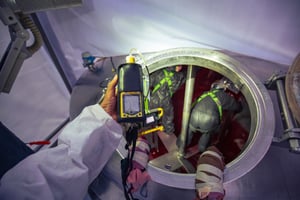
Specifically, a competent gas tester needs to be able to demonstrate:
- Knowledge of the specific gases present in their working environment and the calibration of their detection equipment
- Understanding of LEL thresholds and defined action points — not just what the numbers mean, but what to do when they are reached
- Correct bump testing procedure, carried out before use, every single day
- Atmospheric monitoring both before entry and continuously during confined space work
- Recognition of false or unreliable readings — sensor poisoning, cross-sensitivity, sampling tube limitations
Each of these is a distinct skill. Each requires formal training and verification. And each, if absent, creates a gap that an incident — or an HSE inspector — will find.

The 3-year refresher cycle
Competency is not a one-time achievement. It degrades. Procedures change. Equipment changes. People forget. Industry best practice — and the requirement of most major operators, insurers and clients — is a formal refresher every three years.
We work with teams across petrochemical, gas transmission, power generation and utilities. In our experience, the 3-year cycle is widely understood but inconsistently tracked. The most common situation we encounter is a team where some operatives are current, others are overdue, and nobody is quite sure which is which.
That uncertainty — that gap between what you assume and what you can actually evidence — is where the risk lives.
What to do now
If you are reading this as an HSE Manager and you are not completely certain that every operative authorised to carry out gas testing on your sites has formal, documented, verified competency — that is worth addressing before something forces the issue.
We have built a free Gas Tester Competency Assessment that takes 5 minutes and gives you an instant breakdown of where your team's training stands against the key areas the HSE would examine. It is not a replacement for a formal audit, but it will tell you quickly whether there are gaps worth investigating.
[Take the free assessment here: https://jmsconsultants.co.uk/competency-assessment]
If you would like to talk through your results with one of our specialists, there is an option to book a free 15-minute call at the end. No obligation — just honest advice from people who have been doing this for a long time.