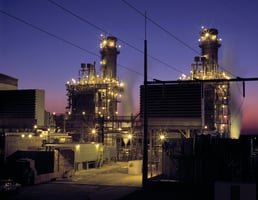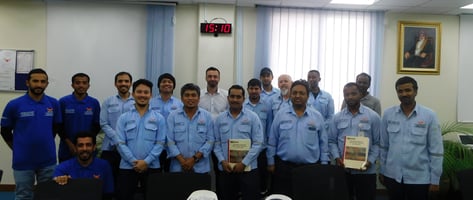
Our Training and Quality Manager, Karl Pearson, visited Phoenix O&M Company LLC to deliver Purging...
Purging is one of those operations that looks simple on paper and bites hard when it isn't planned properly. Get it right and you move a system safely from one state to another — air to gas, gas to air — without ever creating a flammable atmosphere. Get it wrong and you've manufactured exactly the explosive mixture the whole exercise exists to avoid.
At JMS Consultants, purging has been core to our work for over thirty years. This post sets out the recognised methods, and where each one earns its place.
The principle every method shares
Whatever the method, purging exists to do one thing: move a system from one atmosphere to another without dwelling in the flammable range. The job of any purge is to cross the flammable band as cleanly and as quickly as conditions allow — or, better still, to avoid crossing it at all by putting an inert barrier in the way.
That single idea is what separates direct purging from indirect purging.

Direct purging
In direct purging, the incoming medium displaces the outgoing one with no inert gas in between. You push gas straight in to displace air, or push air straight in to displace gas.
The obvious consequence is that the interface between the two media is a flammable mixture, at least transiently. Direct purging is therefore acceptable only where that transition can be managed — typically by maintaining sufficient velocity to keep the flammable zone moving as a short, well-defined front rather than letting it stratify and linger, and by removing ignition sources from the vent area.
Direct purging is generally suited to pipelines, mains and services — long, relatively simple geometries where a clean displacement front can be maintained and the vent monitored to completion. It is far less forgiving on plant with branches, dead-legs and complex internal volumes, which is where indirect methods come in.
Indirect purging
Indirect purging introduces an inert intermediary — usually nitrogen — between the two flammable states. Instead of gas meeting air, gas meets inert, and inert meets air. Because neither interface is flammable, the explosive band is never formed inside the system.
This is the right approach for plant operating with natural gas and other fuel gases, and for any geometry where a clean direct displacement can't be guaranteed. There are four main categories of indirect purging:
Displacement purging
Inert gas is admitted slowly at one end and the resident atmosphere is pushed out at the other, ideally with the denser medium below and the lighter one venting above. The aim is true displacement — a moving boundary with minimal mixing — rather than dilution. Done correctly it's efficient on inert gas usage, but it depends on a favourable geometry and a controlled, low-turbulence flow. Significant dead-legs or pockets can defeat it, because the inert front simply doesn't reach them. Priority is given to the correct inlet pressure and vent size to achieve the required velocity.
Slug purging
A measured "slug" of inert gas is driven through the system as a barrier between the gas and the air, so the two are never in contact. It's economical on inert gas because you're not filling the whole volume — just maintaining a competent separating plug from start to finish.
The critical limitation: slug purging is appropriate only for long pipe runs, and it should not be used on installations with branches unless each branch can be — and is — isolated and purged separately. The slug shortens as it travels (gas diffuses into both ends), so the length of run and the integrity of the slug have to be calculated, not guessed. Lose the slug and you've lost the only thing keeping gas and air apart.
Pressure purging
The system is pressurised with inert gas, then vented, and the cycle is repeated. Each cycle dilutes the residual target gas by a predictable factor, so the concentration falls in steps until it's within criteria. It suits closed vessels and plant that can hold pressure, where a flow-through displacement isn't practical. The trade-off is inert gas consumption — several cycles can use a good deal of nitrogen — balanced against the certainty and repeatability the method gives you on a sealed volume.
Dilution purging
Inert gas is swept continuously through the vapour space to mix with and progressively reduce the concentration of the resident atmosphere. Unlike displacement, dilution relies on mixing, so inlet velocity and the positioning of inlet and outlet matter enormously — the incoming gas needs to reach the far extent of the space, with the vent placed well away from the inlet to avoid short-circuiting. It's a useful method for vessels where good mixing can be achieved, but it's typically the heaviest consumer of inert gas and the least suited to plant with stagnant pockets the dilution flow won't reach.

Vacuum (evacuation) purging
Vacuum purging removes the resident atmosphere by pulling the system down with a vacuum pump, then backfilling with inert gas — and the evacuate-and-replace cycle can be repeated to drive the residual concentration as low as required.
Its strength is that it doesn't depend on sweep geometry or mixing in the same way the flow methods do; a vacuum reaches into pockets and dead-legs that a displacement front would miss. The constraint is mechanical — the system has to be capable of withstanding the negative pressure, and not all plant or pipework is. Where it can be applied, it's one of the most thorough methods available, which is why it's favoured for vessels and high-integrity systems rather than long pipeline runs.
Knowing when the purge is complete
A method is only half the job. The other half is monitoring at the vent and confirming completion against defined criteria — and this is where gas detection earns its keep. Each change of state (gas to inert, inert to air, air to inert, inert to gas) has its own completion point, measured at the vent rather than judged by the clock. The specific thresholds, and how they're applied to a given duty, are exactly the detail we work through on the course — and the part you don't want to be approximating in the field.
The detector matters as much as the number. Reading the right value with the wrong instrument is one of the more common ways a competent-looking purge goes wrong.
Where purges actually fail
Most purging incidents don't come from choosing the wrong method in principle — they come from execution:
-
Dead-legs and branches left in the path of a method that can't reach them
-
Stratification during direct or displacement purging when velocity drops too low
-
Slug loss on runs that were longer, or more branched, than the calculation assumed
-
Instrument error — wrong sensor for the atmosphere, out-of-calibration kit, or sampling at the wrong point
-
Treating completion as a time, not a measurement — purging to the clock instead of to criteria at the vent
Every one of those is a competency issue before it's an equipment issue.

Getting it right, every time
The method is the easy part to write down. Applying it correctly — matching it to the geometry, maintaining the conditions it depends on, monitoring with the right instrument, and proving completion against the criteria — is where experience and current competence make the difference between a routine operation and an incident.
Our Purging of vessels and pipelines course is built around exactly these principles and how to overcome the obstacles.